2011
by David Low
November 17, 2011 - 10:07
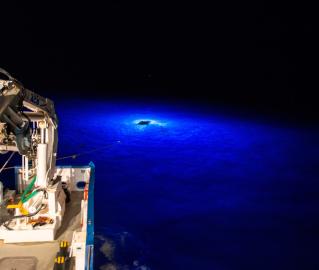
When you’re out here on the ocean doing the work that we all love so well, it’s sometimes hard to remember another life existing. Reality is so in-the-moment, so larger-than-life, and there is little time to reflect or consider times or places other than what is happening right here on deck, with 3500 pounds of metal swinging toward you on a thin cable, or right now in this control van, as we stare intently into the blackness at the periphery of...
by Dwight Coleman
November 15, 2011 - 22:31
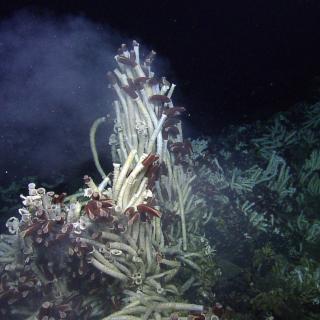
We've had a very productive series of dives this leg exploring large submarine landslide features off the coast of Israel. We discovered seafloor pockmarks and areas of disturbed sediment, a large deep water coral habitat, cold hydrocarbon seeps with large buildups of calcium carbonate and associated deep sea fauna of tube worms and clams, and lots of methane seeps actively emitting gas bubbles and supporting interesting worm communities. The leg was cut short a bit due to a...
by Sharon Pearson
November 15, 2011 - 20:13
Krystal Waltman wrote earlier in a blog about the AERONET Project we are working on with NASA’s Goddard Space Flight Center. We take six handheld sunphotometer readings twice a day onboard Nautilus for use in studies about aerosols in ocean environments. While collecting this data, I wondered how it would be used in the future.
by David Low
November 15, 2011 - 12:59
Many people have asked what this last leg of the mission (the Israel leg) would be looking at, looking for, and what great things we’d get to see. The answer isn’t as obvious as many would expect, unless you’re a geologist. One of the most interesting geological features we’ve run across on previous missions is a number of large mounds of sediment that seem to have fallen in upon themselves, much as a cake will bubble up in the middle and fall after...
by Sharon Pearson
November 15, 2011 - 08:12
Yesterday I sat down with the captain of Nautilus to learn more about him and his job. Pavel was born in Russia and always seemed to have a sense of wonder about the ocean. From the age of 9, he knew he wanted to be a seaman and actually hadn’t considered being the captain of a ship.
by Sharon Pearson
November 14, 2011 - 16:43
If we want to know more about our own earth, scientists must work together to solve the puzzles that await them. The first step in this process onboard Nautilus is a meeting with all scientists included. During this time, permits are reviewed, maps are consulted, targets are chosen, back-up plans are made, and priorities are agreed upon.